



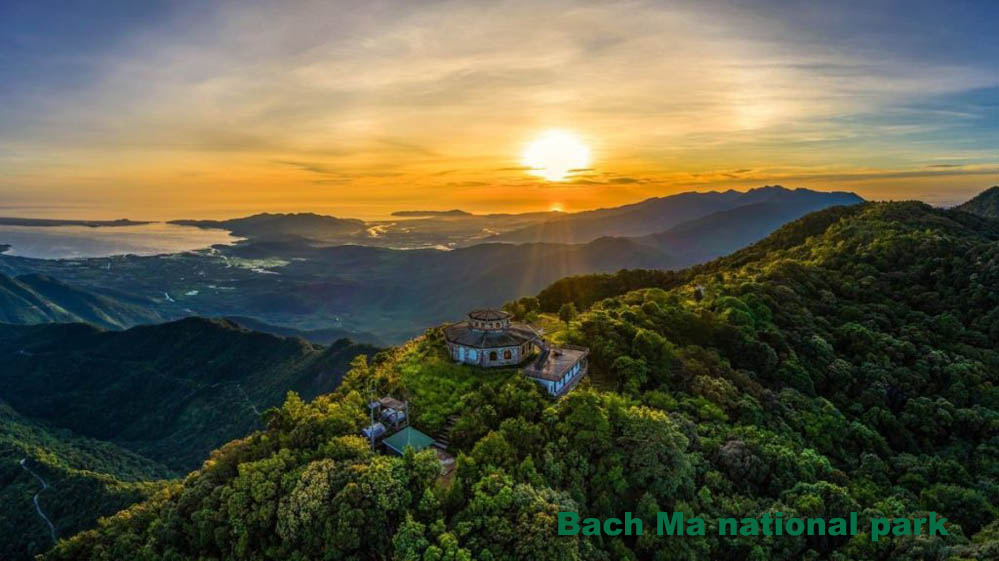
Bach Ma National Park (Phu Loc commune, Hue city) - where the majestic Truong
Son mountain range stretches closest to the East Sea, lies on the natural border
between North and South Vietnam.
This place is blessed by nature with exceptional values in terms of landscape,
climate, and a unique ecosystem, unlike any other in Indochina. From the Vong
Hai Dai viewpoint on the summit of Bach Ma Mountain, over 1,400 meters above sea
level, one can see the entire Cau Hai Lagoon, Tam Giang Lagoon, the East Sea ,
and the endless green forests of the Truong Son mountain range.
Today, Bach Ma is known as one of the national parks with the highest
biodiversity value in Vietnam.
Biodiversity treasures in the Truong Son mountain range
The journey for this land to be identified, studied, and preserved is a story
spanning more than a century, intertwined with many important historical
milestones of the country.
According to Bach Ma National Park, since ancient times, the Bach Ma mountain
range has served as a green wall protecting the coastal plains of Central
Vietnam. The pristine forests here are an important water source for major river
basins, while also creating a magnificent landscape closely associated with the
lives of the local communities. Therefore, Bach Ma has attracted the attention
of many renowned scientists.
The extensive botanical, zoological, and physical geography surveys conducted
throughout the early decades of the 20th century contributed to the inclusion of
Bach Ma Mountain in numerous important scientific works on Indochina.
Botanists such as Eugene Poilane, François Gagnepain, and Pierre Lecomte
collected thousands of rare plant specimens from the central region, many of
which were recorded from the Bach Ma mountain range.
In the field of zoology, Jean Theodore Delacour and Pierre Jabouille conducted
many important studies on the forest bird fauna of Central Vietnam.
Records of endemic bird species, including the White-crested Pheasant, have
further affirmed the exceptional value of this ecosystem.
According to research conducted by Bach Ma National Park, the park is home to
1,728 species belonging to 54 orders and 266 families; of which, 70 species are
listed in the 2007 Vietnam Red Book, 52 species are listed in the IUCN List
(threatened with extinction) in 2016, and 15 species are endemic.
In addition, scientists have investigated and discovered 14 new species, naming
them after the local areas. Several rare animal species have been recorded in
the park, such as the blue-striped snake, white-tailed pheasant, peacock
pheasant, pangolin, mountain goat, saola, etc.
In terms of flora and fungi, Bach Ma National Park has 2,421 species (accounting
for nearly 17% of the total number of plant species in the country), including
74 species listed in the Vietnam Red Book, 20 species listed in the IUCN list,
and 204 endemic species.
Notably, 10 new species have been discovered and named after the Bach Ma area.
Several rare plant species thrive in the garden, such as Dalbergia tonkinensis,
Diospyros melanosa, Terminalia chebula, Terminalia catappa, Terminalia catappa,
and Terminalia chebula.
Bach Ma is protected not only by patrols but also by knowledge. Over the years,
scientists, technicians, and research experts have made significant
contributions to the discovery, documentation, and preservation of the Park's
biodiversity values.
There were surveys lasting months, investigations that had to traverse the most
treacherous areas, and data that took years to complete. Thanks to these
efforts, many unique values of Bach Ma have been discovered and publicized. From
the early days when there were many difficulties, Bach Ma National Park has
gradually built a team of highly qualified, dedicated, and responsible staff.
Forest management and protection activities are becoming increasingly effective,
scientific research is being promoted, international cooperation is expanding,
and there is a focus on applying digital technology , environmental education,
and ecotourism, all of which are gradually developing in a sustainable
direction. These results form the foundation for Bach Ma to confidently enter a
new phase of development.
Transforming biological resources into tourism advantages
Having just experienced a trip to Bach Ma National Park, Nhat, a photographer
from Da Nang city, said: "Bach Ma National Park boasts a diverse ecosystem, many
rare species of flora and fauna, and a cool climate year-round. In particular,
the landscape here possesses a unique beauty, creating a sense of peace and
tranquility, like a place for healing. Every moment of exploration left him with
unforgettable memories".
Nhat hopes that the landslide-affected road will be repaired soon, the
electricity system will be restored, and the old French villas will be renovated
and preserved so that Bach Ma can better develop its tourism potential and
attract more and more tourists to experience it.
According to the Bach Ma National Park Ecotourism, Resort, and Recreation
Project for the period 2024-2030, Bach Ma National Park is planned to organize
ecotourism activities at 12 locations and 14 ecotourism routes.
Activities are primarily located within the service-administrative zone and the
ecological restoration zone; no recreational or leisure activities are permitted
in the strictly protected zone.
According to the Director of Bach Ma National Park, immediately after the
project was approved, Bach Ma National Park proactively implemented the
selection of investors to lease forest land in phase 1 in 13 areas belonging to
the approved ecotourism sites and routes.
As a result, the Park received 17 applications from 12 entities. After the
evaluation process, 10 investors met the requirements, were ranked, and invited
to negotiate contracts with a payment for forest environmental lease of no less
than 1% of total revenue, along with specific commitments and solutions for
forest and environmental protection.
In the coming period, Bach Ma National Park will focus on enhancing the visitor
experience in conjunction with conservation; developing specialized tourism
products, building the Bach Ma ecotourism brand, and strengthening environmental
education through tourism.
Started by former local tour leaders,
AsiaticaTravel.com has emerged as one of the premier service providers for
those wanting to explore Vietnam and Cambodia. Each journey retains that
original sense of adventure that made Asiatica tours so popular, and travelers
also get the chance of enjoying the landscapes, cuisines that the tours have to
offer.
More articles:


