



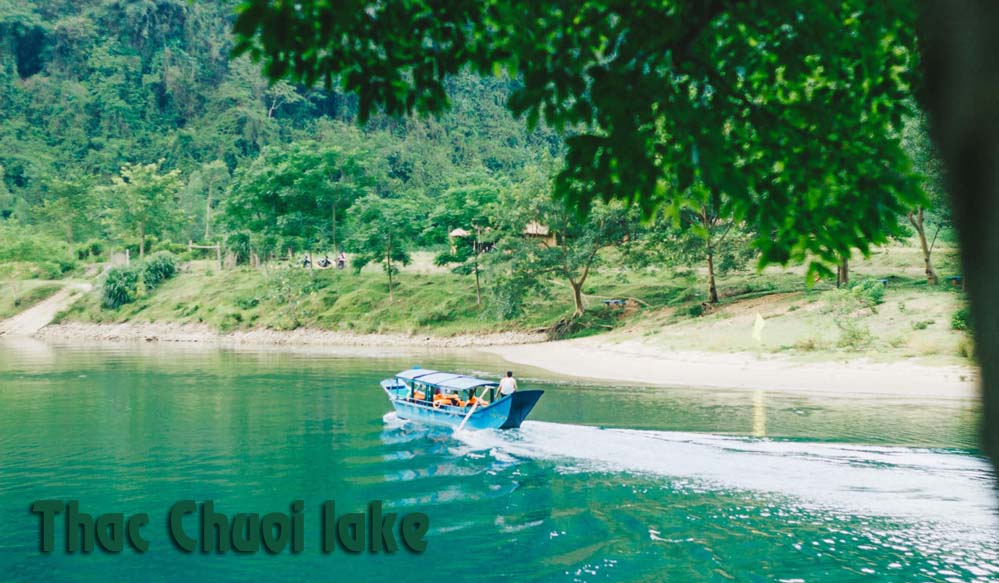
The U Bo Mountain - Thac Chuoi Lake eco-tourism, resort, and entertainment
complex project is expected to create a new tourism hub, expanding the space and
attractiveness of Quang Tri tourism.
With a total investment of over 16,234 billion VND, a scale of over 167
hectares, and a target of welcoming approximately 3 million visitors per year,
the U Bo Mountain - Thac Chuoi Lake Eco- tourism, Resort and Entertainment
Complex Project is expected to create a new tourism hub, expanding the space and
attractiveness of Quang Tri tourism.
Where mountains, lakes, and historical memories meet
U Bo Mountain is located at an altitude of over 1,000m, amidst the mountainous
forests of western Quang Tri , a region with a cool climate, a natural forest
ecosystem, and roads steeped in the legendary history of the Truong Son
Mountains. At the foot of the mountain lies Thac Chuoi Lake, a reservoir with a
capacity of nearly 33 million cubic meters, serving both agricultural production
and water supply purposes, while also creating a vast ecological space.
This is a key differentiating factor of the U Bo Mountain - Thac Chuoi Lake
Project. While Quang Tri tourism has long been strongly characterized by its
beaches, natural heritage, and cave systems, U Bo - Thac Chuoi can add a product
at high altitude, combining relaxation, ecology, recreation, and nature
exploration.
This area is also located on the western branch of the Ho Chi Minh Trail ,
connecting to landmarks associated with the 20th Victory Road, the Eight Girls'
Cave, and many other traces of the route and the legendary Truong Son mountain
range. If properly organized, a trip to U Bo - Thac Chuoi could be more than
just a relaxing getaway amidst the mountains; it could also connect with a world
natural heritage site, historical and cultural tourism, and a journey of
memories.
The project, approved for investment in March 2026, is located in the communes
of Bo Trach, Thuong Trach, and Truong Son. According to the plan, the complex
includes a hotel, resort villas, serviced apartments, a commercial and service
area, entertainment facilities, and five cable car lines connecting the
foothills to the summit of U Bo.
The target of approximately 3 million visitors per year is noteworthy. Compared
to Quang Tri's target of 10.5 million visitors in 2026, the projected scale of U
Bo - Thac Chuoi alone is equivalent to nearly 30%. However, it is unclear
whether the project will automatically increase the province's total visitor
numbers by 3 million, as some tourists may already be visiting Quang Tri and
simply changing their destination with the addition of this new attraction.
What people should be more concerned about is whether the project will generate
new customer traffic, encourage longer stays, increase spending, and
consequently boost business and service activities in other areas.
Historian Dr. Nguyen Khac Thai argues that U Bo - Thac Chuoi should not be
viewed as a separate, independent destination. Current tourism trends demand the
integration of regional resources, destination linkages, and service
development. Therefore, the project's value can only be fully realized when
placed within a larger framework, connecting the natural landscape with the
historical and cultural values of Quang Tri.
Visitors to U Bo - Thac Chuoi not only enjoy a relaxing vacation but can also
continue exploring the Truong Son Mountains, the Highway 20 Quyet Thang, the
Phong Nha-Ke Bang World Natural Heritage Site , and other historical, cultural,
mountainous, and coastal destinations in the area. By establishing
interconnected itineraries, the project can contribute to longer stays for
tourists, increase spending, and create opportunities for many localities and
businesses to participate in the tourism value chain.
Thai emphasized that the overarching principle for U Bo -T hac Chuoi must be
sustainable development, in which the landscape ecosystem, tourism products, and
linkages between destinations must all be built in a sustainable manner.
Quang Tri Province assessed that large-scale tourism projects are of significant
importance to the province's development and requested relevant agencies and
units to focus on completing procedures and resolving obstacles to ensure the
projects are implemented on schedule. Regarding the U Bo Mountain - Thac Chuoi
Lake project, the province is striving to complete all necessary conditions to
commence construction in October 2026.
Placed within the province's tourism development plan, U Bo - Thac Chuoi is
therefore seen not only as a major investment project, but also as a test of its
ability to create a new product with sufficient appeal to complement the
existing system of destinations.
U Bo - Thac Chuoi is not simply a resort but aims to be a complete tourism
complex. Once operational, the project could create significant demand for
transportation, accommodation, food and beverage, commerce, experiential
services, and tourism personnel; thereby creating opportunities for businesses
and local people to participate more deeply in the value chain.
This is also why the project can be located next to tourist attractions that has
previously been developed at Ba Na Hills or Fansipan. At these destinations, the
cable car system not only solves the access problem but also becomes part of a
larger tourism product, linked to relaxation, entertainment, services, and
experiences.
However, U Bo - Thac Chuoi presents a unique and more challenging problem: the
need to balance exploitation and conservation. The appeal of this place lies in
its mountains and forests, the natural landscape of the Phong Nha - Ke Bang
World Heritage Site, Thac Chuoi Lake, and the legendary historical Truong Son
mountain range.
According to the project documents, the total area to be implemented is
approximately 167.48 hectares, of which the planned forest conversion area is
about 158.61 hectares, including more than 148.25 hectares of natural forest.
This is an issue that needs special attention during implementation. An
ecotourism project will find it difficult to create sustainable value if the
very resources that make the destination attractive are damaged.
Quang Tri province also witnessed a "missed opportunity" with the idea of a
cable car in the Phong Nha-Ke Bang World Natural Heritage site. In 2014, a
survey of a cable car plan to Son Doong Cave, with a proposed length of
approximately 10.6 km and an estimated investment of 4,500 billion VND. However,
this plan was not included in the national park's planning at that time due to
the need for further research, evaluation, and consultation with specialized
agencies, UNESCO.
More than a decade later, the cable car story returns with the U Bo
Mountain-Thac Chuoi Lake Project, but in a different context and approach.
However, the biggest challenge remains not how many people can be brought up the
mountain, but what value can be created from that influx of visitors.
If each tourist only visits U Bo - Thac Chuoi and then leaves, the impact on the
tourism economy of Quang Tri province will be limited. Conversely, if U Bo -
Thac Chuoi becomes the starting point or connecting point in the journey to
explore Phong Nha-Ke Bang, the Truong Son road, historical and cultural
destinations, and coastal areas, the project could create a longer chain of
experiences and extend the length of stay.
At that time, 3 million visitors was not just a figure representing operating
capacity. The greater value lay in the number of new visitors generated, the
increased length of stay, higher spending levels, and the revenue spillover to
businesses and people outside the project area.
Therefore, U Bo - Thac Chuoi could become a new "flagship" and "driving force"
for Quang Tri tourism, but this "flagship" and "driving force" should not be
determined solely by the scale of capital or the number of cable car lines. It
must be proven by its ability to create a distinctive tourism product, attract
new tourists, and connect the many values of Quang Tri today. Only then will the
more than 16.234 billion VND invested in the project truly become a "flagship"
and "driving force" that will spread throughout the entire area, enabling
tourism in Quang Tri province to take off.
What sets
AsiaticaTravel.com apart are our dedicated tour advisors who design each
tour in collaboration with our extensive network of supplier partners in Vietnam
and Indochina. We are able to offer such amazing values thanks to our
long-standing relationships with service providers, we negotiate the best price,
and pass this savings on to our customers.
More articles:


